
What My FYP Reveals About Me: Algorithmic Inference and the Politics of Personalisation.

I spent 15 minutes scrolling TikTok’s ForYou page, documenting the first three videos substantial enough to analyse. TikTok’s interface feels spontaneous, but the underlying selection is neither random nor neutral.
Here’s what I encountered:
Video 1: A cute dog video featuring a rescued puppy
This aligns with data points the platform likely has:
- my history of engaging with dog and animal-related content
- repeated interactions with rescue, training, and pet-care videos
- possible inferences about emotional preferences, lifestyle, or affective attachments
Under Davies’ framework, this reflects predictive personalisation: systems infer future preferences from behavioural fragments, using past emotional engagement (likes, watch time, saves) to anticipate what will keep me watching.

Video 2: A cooking video featuring Italian regional recipes
Given my browsing history and location patterns, TikTok likely tags me with:
• interest in Italian culture
• preference for food content
• engagement with homeland-oriented media
This illustrates Noble’s argument: algorithms don’t just reflect identity; they construct it, reinforcing racialised, nationalised, or culturally essentialised categories.

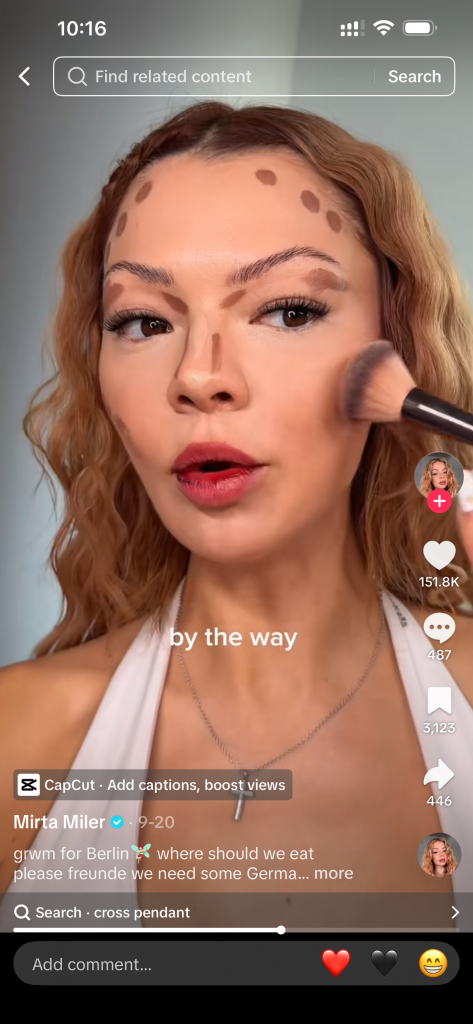
Video 3: A “beauty advice” clip from a beauty influencer
This content functions ideologically:
- It presumes the viewer is, or wants to be, physically optimised, aesthetically disciplined, and continuously “work in progress”.
- It reflects platform capitalism’s tendency to frame self-worth through appearance, routine, and consumption-driven transformation.
TikTok’s model privileges content that aligns with platform monetisation goals: beauty influencers drive high watch time, constant product turnover, and some of the most lucrative advertising partnerships on the platform.
Hypothesising the algorithmic logic
TikTok optimises for:
- Behavioural similarity clustering
Users are grouped into micro-cohorts based on interaction patterns.
2. Retention probability
Videos that maximise the chance of staying on the app are prioritised.
3. Advertiser alignment
Certain categories (finance, beauty, lifestyle) are more profitable.
4. Identity inference
The system constructs probabilistic profiles (nationality, age, linguistic preferences, socioeconomic interest).

Racial capitalism in the feed
Although none of the videos were explicitly racialised, the underlying logics are. TikTok’s recommendation engine operationalises value extraction through categorisation:
• users are segmented through inferred demographic and cultural traits
• these traits become vectors for targeted content and monetisation
• certain creators and communities gain visibility while others are invisibilised
Noble’s work on algorithmic oppression helps explain how neutral-seeming personalisation can reinforce structural hierarchies, even when the feed appears “personal” rather than “racial.”
The FYP is not a window into your interests; it is a prediction engine trained to monetise your identity.The FYP is not a window into your interests; it is a prediction engine trained to monetise your identity.

The FYP is not a window into
your interests; it is a prediction engine
trained to monetise your identity.
Conclusion
My FYP felt tailored, but the tailoring revealed more about TikTok’s economic imperatives than about me. The platform optimises not for self-expression but for data extraction, predictive modelling, and advertiser-aligned behavioural shaping.
In the end, scrolling the feed becomes a way of observing how algorithms interpret and instrumentalise the self within broader systems of racialised and economic power.
What unsettles me most is how quickly the algorithm stabilises into something that feels predictable. After only a few minutes, the diversity of the feed contracts into a narrow loop of recognisable categories: tech, finance, lifestyle, and culturally proximate content. This narrowing effect produces a feedback loop in which past behaviour quietly pre-determines future visibility. Rather than expanding my horizon, the FYP increasingly consolidates it.
There is also an affective dimension to this process. Each video carries an implicit message about what someone like me should care about, aspire to, or purchase. Over time, these micro-suggestions accumulate into a soft form of behavioural governance. I am not instructed directly, but nudged continuously.
Viewed through the lens of racial capitalism, this governance is unevenly distributed. Some identities are rendered hyper-visible and profitable, while others remain marginal and under-monetised. The algorithm does not merely recommend content, it actively participates in the economic sorting of lives, desires, and futures.
Leave a Reply